
Contra Costa County Recent Arrests
The Contra Costa County Office of the Sheriff runs the county's custody system. Arrests by the Sheriff, city police, or the California Highway Patrol rarely share one path. Some people are cited and released. Others get booked at Martinez Detention Facility, transferred, or held in another jurisdiction. Anyone held in Sheriff custody right now is easy to check. Use the official Individual in Custody Locator. It spans the centralized system, including the Martinez, West County, and Marsh Creek facilities. Remember its limit. It is not an arrest-history database.
There is no live same-day Sheriff feed. The Inmate Reports page is the official spot to watch for restored reports. Arrest data once stayed visible for about 30 days. That detail comes from one historic report. It does not prove a current feed or archive.
| View | Purpose | Route |
|---|---|---|
| Daily Arrest Report | Same-day checking | Live custody locator first |
| Weekly Arrest Log | Multi-day and archive context | Targeted records request |
| VINELink Inmate Check | Custody alerts for one person | Verify urgent status with Sheriff |
When Arrests Reach the Locator
Timing explains many failed searches. An officer can make an arrest well before transport and intake are complete, and during that gap a name search may return nothing. Release works the other way, pulling a person out of a current-custody search while agency and court records live on. Search the full first and last name first. Then retry with a known booking number. Spelling matters, so double-check it. If nothing matches, call the arresting agency to ask whether the person was cited, released, or booked somewhere else.
Contra Costa County publishes no VINE refresh interval. The Sheriff lists no booking app either. Stick with the official custody locator, since third-party apps may serve stale scraped data.
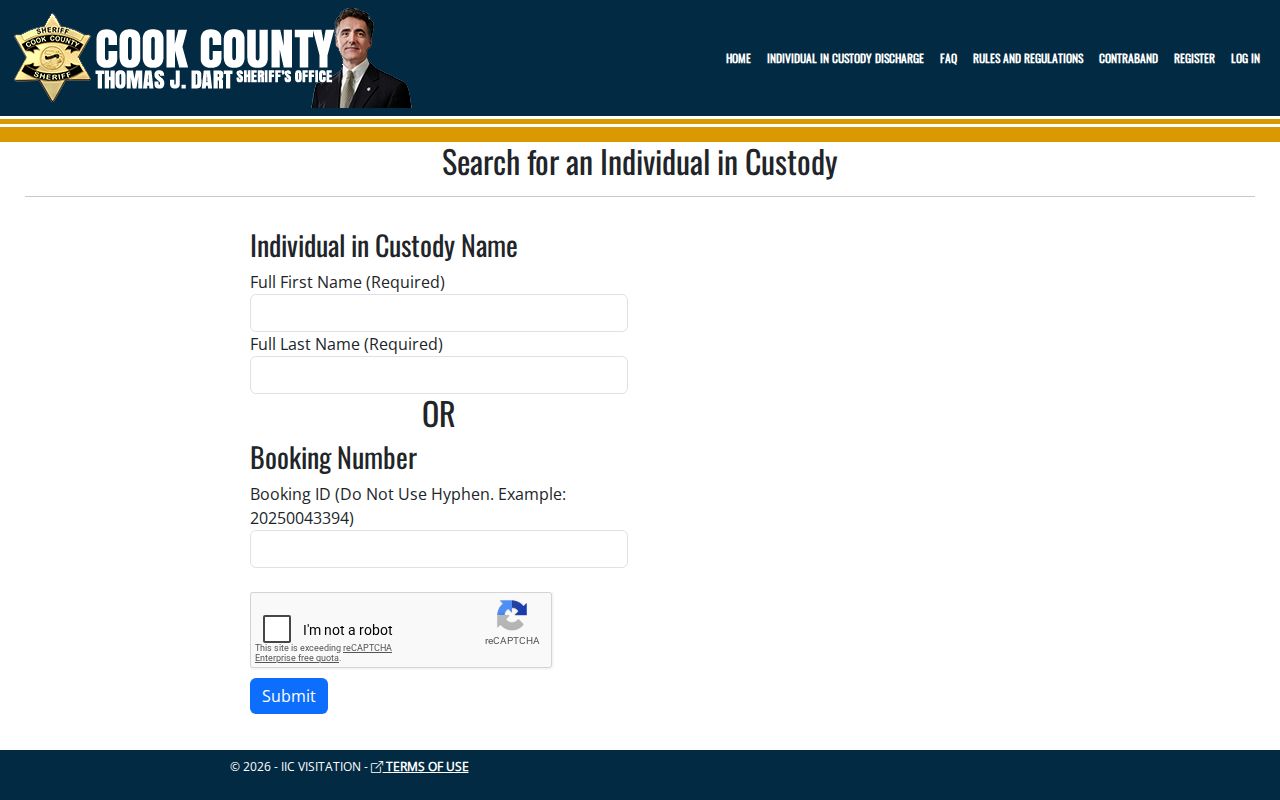
The capture documents the official form without displaying or rehosting a person’s photograph.
Contra Costa County Arrest Roster
The roster is a query, not a browsable list. It demands a complete first and last name or a booking number, plus a reCAPTCHA check. The form warns against a hyphen in the numeric booking identifier. No archive depth is stated. No photo field is advertised. A booking photo may still sit in Sheriff files, but the results interface does not show one.
| Field | Use | Limit |
|---|---|---|
| Full name | Current custody search | A name alone cannot confirm identity |
| Booking number | Precise numeric search | Must already be known |
| reCAPTCHA | Human verification | Prevents an open bulk roster |
Search the legal name first. Compare facility and intake details, allow for booking lag, and call custody staff when status truly matters. VINE handles alerts. After release, request a booking sheet, since a disappearance from the roster can follow bail, citation, transfer, court order, or time served.
Where County Arrests Get Published
Official systems come first. The locator shows present Sheriff custody, city logs show events, and court records show later case action. Press releases are selective. CDCR covers state custody, not fresh county bookings, and third-party pages work only as leads to check against an official custodian.
| Channel | Photo | Role |
|---|---|---|
| Sheriff locator | No field verified | Official current custody |
| City logs | Varies | Incident context, not roster |
| Superior Court | No | Case and disposition |
| RecentlyBooked | Conflicting statements | Unofficial 30-day-looking lead |
| Mugshots.com | Historic | Unofficial pages observed mainly 2004–2016 |
Sheriff press releases lead the official news routes. They never form a complete list. Contra Costa News, Richmond Standard, East Bay Times, and the Chronicle publish selected stories. Editorial images are not mugshots. Police-supplied photos are not booking pictures either. That holds unless they are identified as such. Local routes on BustedNewspaper, Arrests.org, and Mugshots.zone are absent, inaccessible, or redirected. For booking-volume trends, the caveated secondary booking-statistics report remains worth a read.
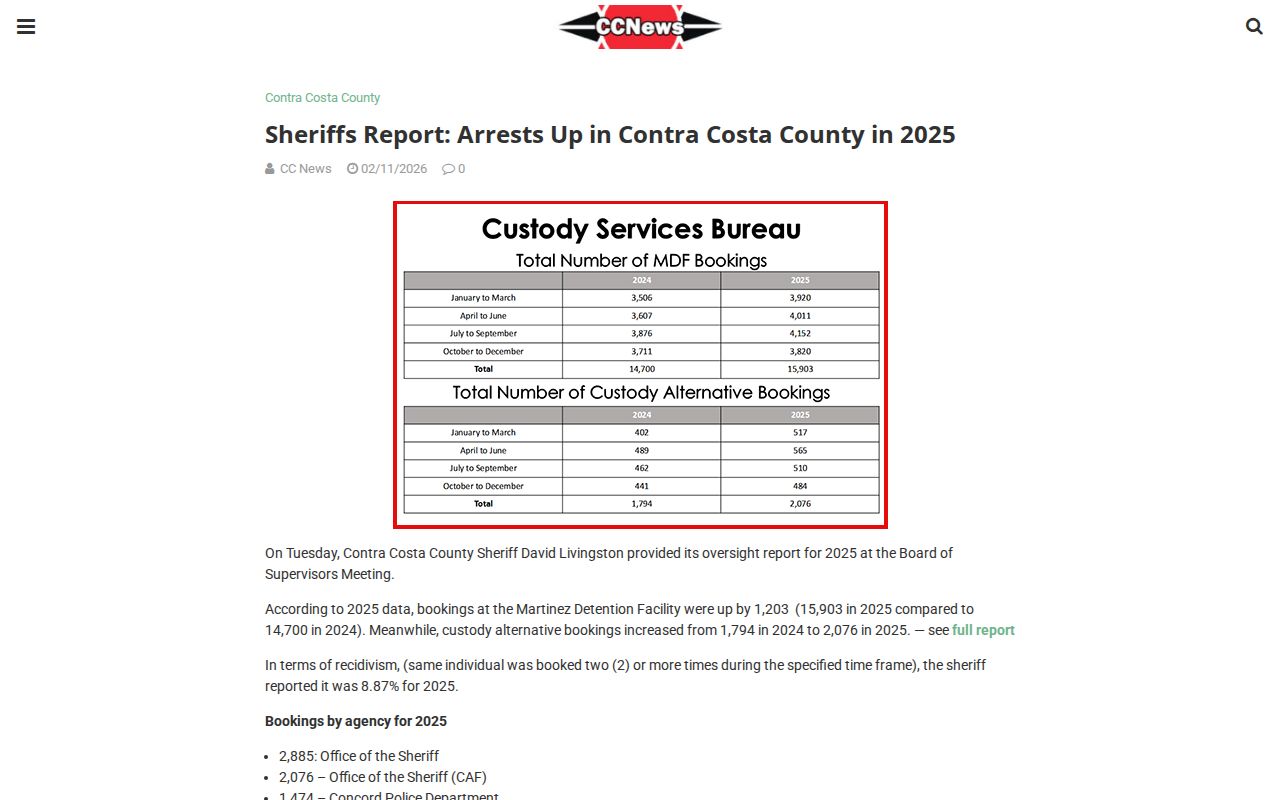
The report adds scale, but never replaces a current person-level official check.
Recent Arrests by City
Each city page takes a different angle. Concord Recent Arrests ties Police records and crime-map context to county custody. Richmond Recent Arrests separates the CAD/RMS incident log from booking records. A "WARRANT ARREST" entry there may omit the name. Martinez Recent Arrests covers Citizen RIMS, which posts after calls close rather than in real time. All three differ from the Sheriff roster.
Contra Costa Arrest Record Fields
Booking means jail intake. The historic official report offers the fullest field inventory, even though it is not a current schema. It listed booking ID and arrest and booking times. Each had its own timestamp. It also covered arrest type and location, charge code and description, race, gender, release date, and release type.
Some details are protected. The law allows withholding in sexual assault, domestic violence, and crimes-against-children cases. Certain mental-health events are also protected. Juvenile records follow a separate court process. A blank field can reflect a lawful limit rather than an error.
- Arraignment
- The first court stage addressing charges and rights.
- Bail
- A release condition; a schedule cannot predict one person’s release.
- Disposition
- The later court outcome.
- Sealing
- A limit on public access, not always destruction of every copy.
Contra Costa Arrest Photos
The Sheriff posts no official mugshot gallery. Ask Custody Administrative Services for an in-custody booking image or booking sheet. Records & ID handles Sheriff reports. That unit also fields out-of-custody inquiries. Include the full legal name, approximate date, booking number, and facility, and request the segregable public portions plus the legal basis for any withholding.
State custody is different. The CDCR locator covers state prison only. It may return identity, location, admission, and parole data, though it advertises no photo field. CDCR media policy offers a separate image-request route, and state prison data never counts as a fresh county arrest.
Request Contra Costa Arrest Records
The Records & ID Unit sits at 2530 Arnold Drive, Suite 170, Martinez, CA 94553, and answers (925) 335-1570 on weekdays from 8:00 a.m. to 5:00 p.m. Email recordsinfo@so.cccounty.us works too. Custody Administrative Services handles in-custody requests separately. Its listed email is csbrecords@so.cccounty.us.
- Ask the arresting agency for its report and Sheriff custody staff for the booking record.
- Give the name, dates, booking or case number, and facility.
- Request segregable non-exempt portions and a fee estimate.
- Keep any exemption response and check court disposition.
Contra Costa answers a public records request within ten days. That clock covers only the initial decision, not delivery of the files. Fees run small but add up across copies. Single-sided pages cost ten cents, and double-sided pages run twenty. A CD costs three dollars. The Sheriff check runs no more than $15. No flat fee applies to booking photos, and court records follow a different schedule. Pages cost fifty cents, plus forty dollars for certification. Start through the county request portal.
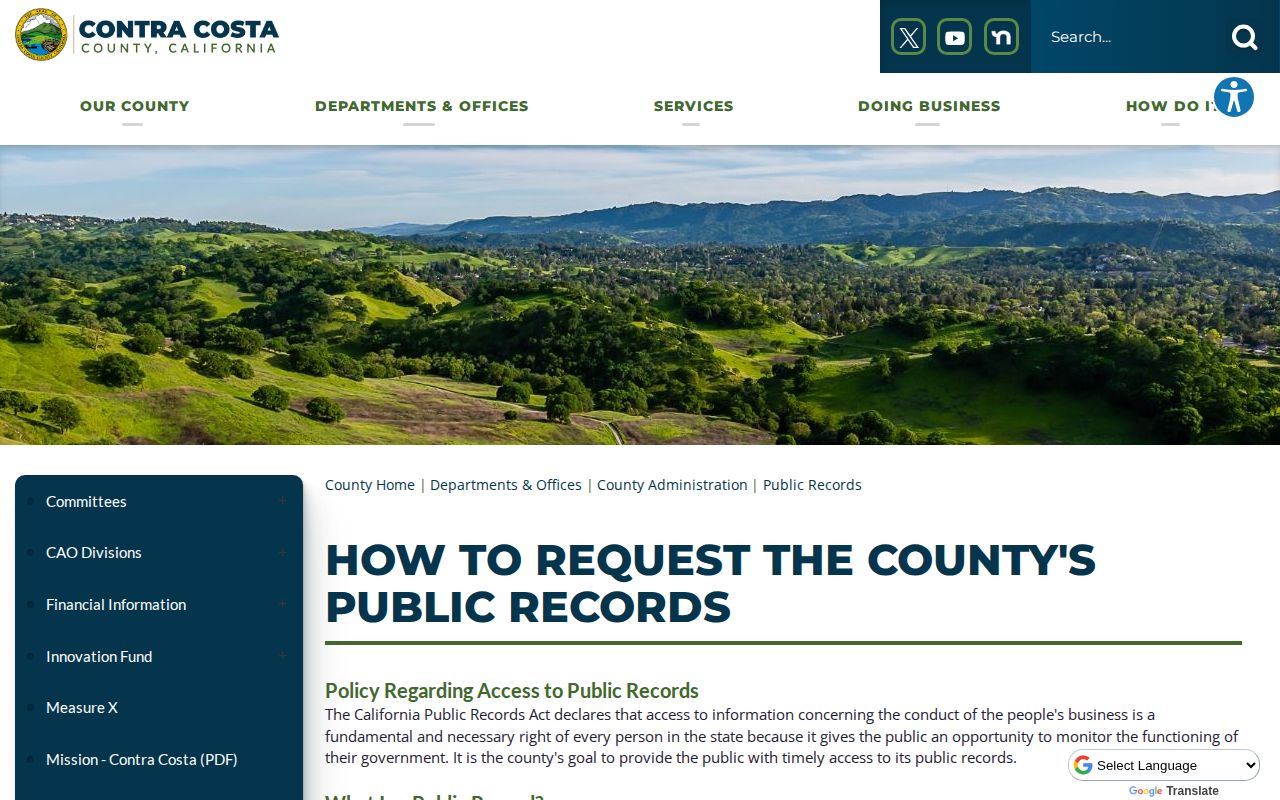
The portal identifies the holding agency, but does not guarantee disclosure.
California Arrest Photo Law
Filing a CPRA request starts a process, yet the law never promises every page. Government Code 7922.535 sets the timeline for that first determination. Exemptions for privacy and active investigations can still block release. Booking photos get separate treatment. Penal Code 13665 limits how law enforcement posts arrest photos on social media in certain nonviolent cases. Its exceptions leave room. The statute does not erase anything. Civil Code 1798.91.1 targets publishers that charge people to take criminal-record material down. Never pay a stranger who promises removal. Fix the record at its source. Pursue court sealing where eligible if a case qualifies. Use a publisher's written free policy. Then refresh outdated search hits. RecentlyBooked and Mugshots.com both describe free review on listed grounds. Read the official statute for the exact wording. Policies shift, and each one covers only that site's own copies.
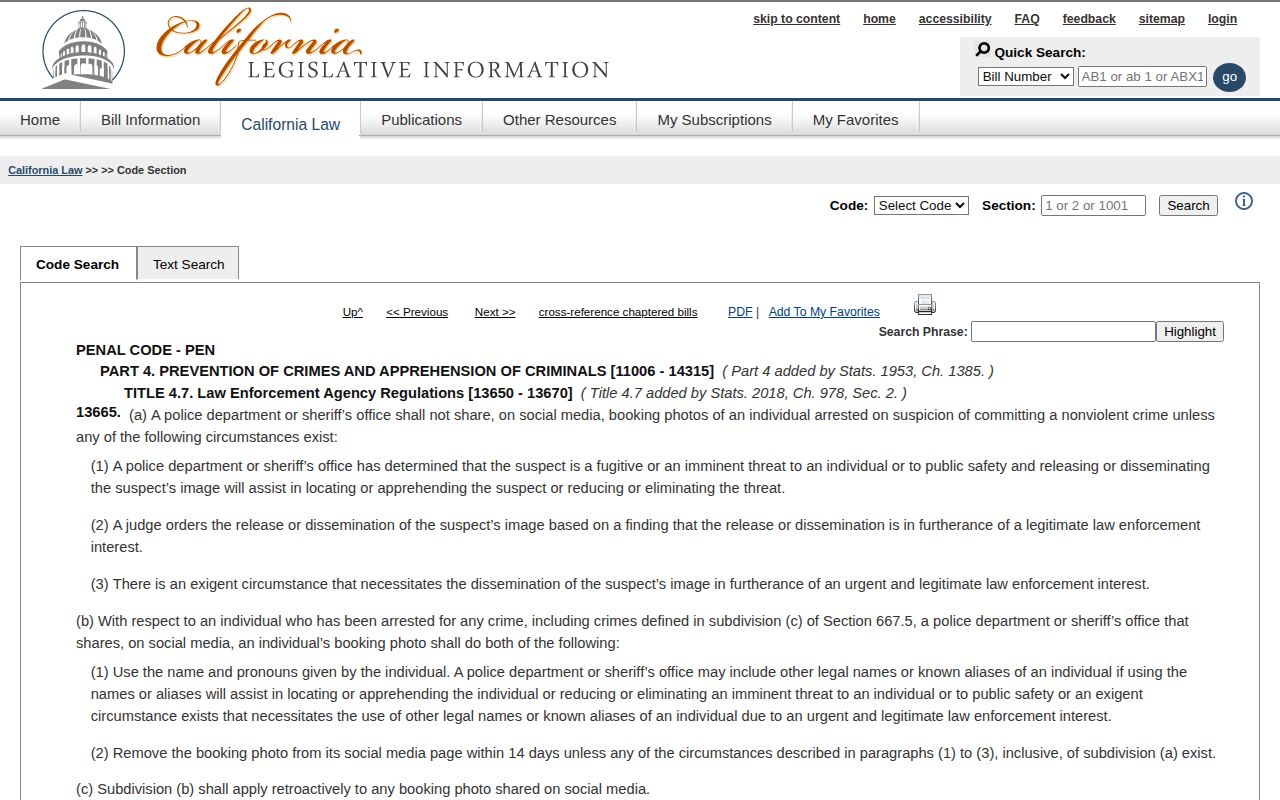
The capture shows a narrow social-post rule, not universal removal rights.
Older Contra Costa Arrest Records
That old 30-day window on the Sheriff's website was administrative, not a destruction clock. Retention is a question for Records & ID. Custody Administrative Services can also say whether an arrest record was kept, moved, sealed, or destroyed under policy. State holdings tell a different story. The State Archives photo guide documents historic prison collections, not current Sheriff mugshots. For older Contra Costa bookings, try county archives, the Historical Society, and newspaper runs at the library. Treat each as a lead rather than a guaranteed source.
Contra Costa Arrest Warrants
Contra Costa publishes no countywide warrant portal through the Sheriff. The department points people to the court or their local police instead. Superior Court sits at 725 Court Street in Martinez, reachable at (925) 608-1000. Court staff or qualified counsel are the right channel for a possible warrant. They can check it and resolve it. Outrunning one is never the answer. The Sheriff's Most Wanted page serves a safety purpose. It is not a warrant search or arrest feed. It listed three profiles with older narratives and no posted update schedule. Never approach anyone shown there. Call 911 for immediate danger; other tips go to (925) 313-2600 or (866) 846-3592.
After a Contra Costa Arrest
An arrest record only tells part of the story. The Superior Court record route links a Contra Costa booking with its court case. It shows what the court later decides. Case data shows in the portal. Minutes, orders, and documents take a records request on form CR-147 or CR-114. Bail schedules effective July 8, 2026 explain some custody shifts without predicting release. Cases get amended, diverted, dismissed, tried, or sealed along the way. Use the official portal entry to begin.
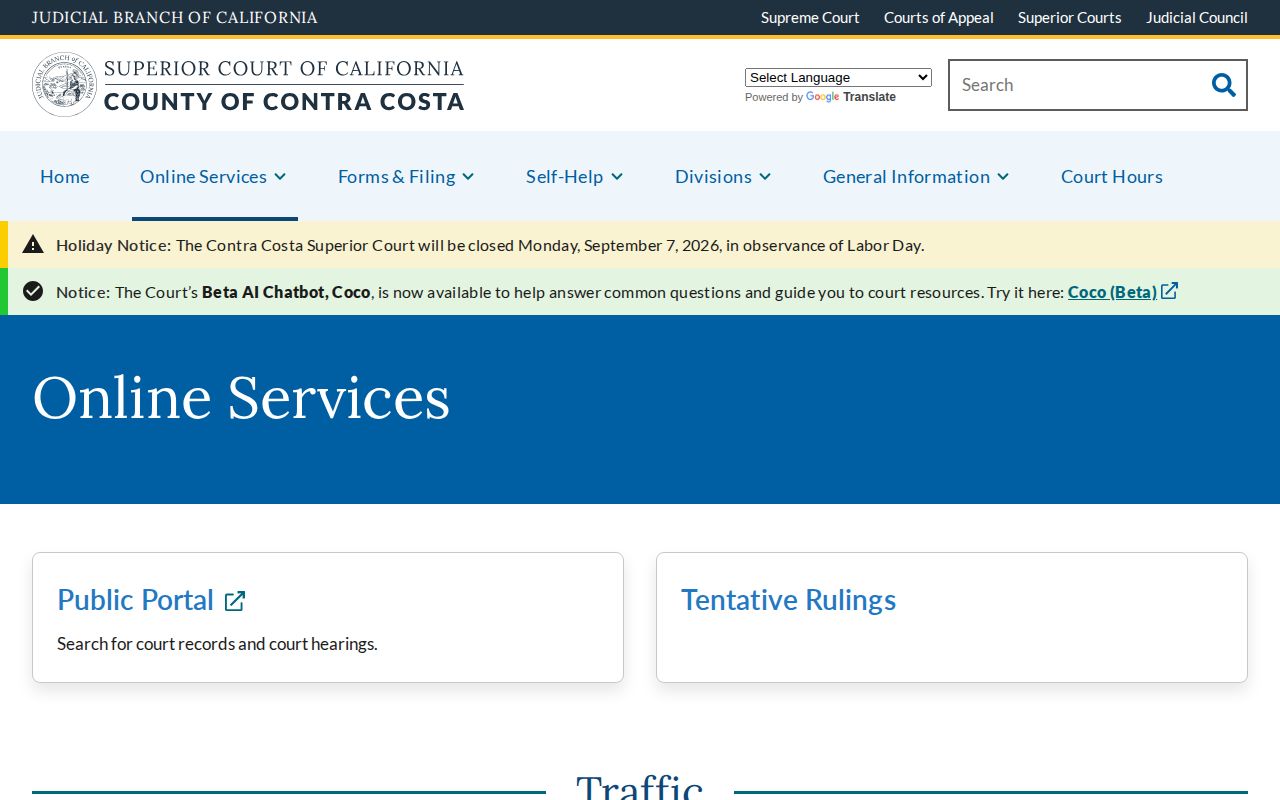
The court is the later evidence layer, while full orders remain request-based.
Custody Beyond County Arrests
Custody spreads across systems once an arrest leaves the county jail. State prison belongs to CDCR. The BOP locator tracks federal inmates from 1982 onward. It covers mostly sentenced custody. It offers no mugshot gallery. ICE runs its own locator, and results can lag behind reality. Sheriff material notes that release dates left the county site in 2021. So county pages cannot settle immigration status or ICE timing. Federal pretrial custody may require the federal court, the facility, an attorney, or the U.S. Marshals district office.
Transfers complicate notification too. CDCR's victim-services material flags a transition once a person enters state custody. County VINE registration does not automatically follow that move. A reader may need the state's separate service plus a CDCR number. BOP likewise describes one federal system, not every defendant held before federal sentencing. ICE demands its own identity fields and warns of delays. A missing match proves nothing about status, release, or whether an arrest happened.
The Sheriff's three detention facilities stay separate from all of this. Martinez Detention Facility handles central booking and appears constantly in official and news material. West County Detention Facility serves the county system from Richmond. Marsh Creek rounds out the Sheriff's sites. Search the centralized locator rather than guessing housing from the arrest city. A transfer can switch the right locator. The original arrest record stays with the police, the Sheriff, and the court.
Follow a Contra Costa Arrest
A thorough lookup follows the record forward in time. Start with the likely arresting agency and its incident report. Then search the Sheriff locator for current custody. A hit means recording the booking number and facility. Remember that early charges can change. VINE helps when release or transfer alerts matter. An empty result deserves patience. Consider booking lag, a citation, release, transfer, name spelling, or custody held elsewhere before concluding anything.
Once a court case surfaces, the Superior Court portal supplies its number, hearings, and status. Request minutes or orders when the summary stops short of the outcome. A state prison sentence moves the search to CDCR. Federal sentenced custody belongs in BOP. ICE and federal pretrial custody each use separate systems. Keeping each locator inside its true coverage prevents wasted effort.
For a booking photograph, first see whether an agency published one. Then request the exact image from its custodian. Skip news photos and stale third-party profiles. Keep the source date and weigh corrections against court records. Ask about retention before assuming older material landed in an archive.
When sources disagree: trust the office that created the record closest to your question. Sheriff custody data controls present local custody. The police report controls that agency's account. The court controls the outcome. Write down when each was checked. Gaps usually trace to delay, transfer, release, amendment, sealing, or mistaken identity.
Contra Costa Arrest Record Fees
Fees in Contra Costa County hinge on which office keeps the file. A police report, a Sheriff booking sheet, and a court case file sit with three different custodians. Each sets its own rates. Concord charges $20 for reports, $45 for clearance letters, and $15 for repository receipts. Richmond prices common reports at $10 and clearance letters at $40. In Martinez, reproducing a crime report or incident note runs $3. None of these city figures establish what a Sheriff booking photo costs, because that fee flows from the Sheriff's own response to a request.
County CPRA examples show actual charges can climb past pocket change. Electronic extraction, certification, and mailing each carry their own price. Court copies run fifty cents per page plus $40 to certify, so request an estimate up front and name the right custodian.
Why Arrest Details May Be Missing
A thin arrest entry usually reflects policy, not failure. Old Sheriff material in Contra Costa County spells out what gets held back. Protected material includes victim identities and sensitive locations in domestic violence cases, sex offenses, crimes against children, and certain mental-health calls. Juvenile records travel through a court process instead. Ongoing investigations and privacy rules can narrow access further. When you ask, request all reasonably segregable public material. Ask for the stated legal ground on anything withheld.
These limits exist for good reason. They shield victims, children, witnesses, and people in a health crisis from exposure. Private addresses and medical details stay out of public summaries too. Court access and jail access follow different rules. A sealed record can vanish from view later.
County Arrest Counts Need Context
Numbers help, but they answer a different question than a roster would. The Sheriff transparency portal publishes statistics rather than names. Local reporting described Martinez Detention Facility bookings rising in 2025 over 2024. Agency totals came with them. Scale is useful. It will not tell you who is in custody now. Nor will it say why the count moved or how a case ended.
City arrest totals diverge from county jail admissions. Plenty of arrests never reach the Sheriff. When precision counts, use the official dashboard and pin down the period and agency. One facility cannot stand in for every detention division and custody alternative. News stories can point you back to the source. The locator remains the tool for a named-person check.
Arrest Allegations Can Change
A disposition check starts in the Court Public Portal but does not finish there. Contra Costa Superior Court states this plainly. Minutes, documents, and orders are absent from its criminal-record page. Form CR-147 supports record searches; CR-114 handles copies. What you pull may show an original sentence while missing later changes.
Cases move after arrest. Prosecutors can decline to file, reduce a count, or amend the charges. Courts dismiss, divert, acquit, convict, or seal. The Sheriff locator answers current custody only, never the court outcome. Check both layers when release came before filing or an old arrest page outlives the case.
Contra Costa County Office of the Sheriff Location and Directions
Public Record Search
Sponsored Results