
How Richmond Arrest Records Split
Richmond Police records the city's side of each event. Its dispatch and records systems feed the Daily Incident Log. The arrest report itself stays with the Police Records Section. Booking works differently. County booking starts with the Sheriff. When someone arrested in Richmond enters a Contra Costa County jail, the Sheriff opens the booking record. Later a prosecutor and the Superior Court can build a criminal case. One event may surface in several layers without matching facts.
Richmond counted 116,448 residents in the 2020 Census figures the county publishes. That makes it the second-largest city on this map. The city keeps its own police department. It also keeps a real daily incident source, which not every town here can claim. The log still is not a named roster. One call entry carries a block, a time, a type, and a disposition. It never names who was booked.
Richmond Daily Arrest Log Limits
The official Daily Incident Log pulls straight from CAD and RMS calls-for-service data. CAD stands for computer-aided dispatch. RMS means records management system. Representative reports list the date and time, an incident number, priority, a block-level location, the incident type, and a disposition. The public extract is labeled unaudited. It is also subject to change.
Some entries carry a "WARRANT ARREST" disposition. That phrase shows how the call was coded at that point, nothing more. It names no person. It shows no booking photograph and proves no Contra Costa jail stay. The shared communications arrangement covering Richmond and El Cerrito makes the stream useful for context, but a listed call still must be matched to the arresting agency and the right custody system.
Treat the log as a lead. Save the incident number, time, block, and description, then ask the Richmond Records Section for the report and search the Sheriff locator for current county custody.
Where Richmond Recent Arrests Appear
No single source answers every question about Richmond arrests. The city offers more event detail than a plain crime map. Official sources come first. Each one holds a different spot in the sequence from arrest to court, and each plays a defined role.
| Source | Best use | Names or photos | Status |
|---|---|---|---|
| Daily Incident Log | Calls, event types, locations, and dispositions | Not a named booking-photo roster | Official city, unaudited |
| Police press releases | Selected Richmond Police events | May include an agency image | Official but selective |
| Sheriff locator | Current Contra Costa custody | Name search; no advertised photo field | Official county |
| Superior Court | Later case information and requests | Not a mugshot feed | Official court |
| Local journalism | Selected arrest narratives | Editorial or police-supplied images | Unofficial; verify |
A photo in a Richmond Police release can serve as evidence, a courtesy image, or an identification shot. Never label it a booking photo by guesswork. The release must say so. News outlets and unofficial record sites also keep old claims online long after custody or charges change.
Look Up Someone Arrested in Richmond
Start with what you know. Gather the full name, event date, incident number, arresting agency, and likely jurisdiction. Not all cases end at the West County Detention Facility. Someone arrested in Richmond can be cited or released. They can also be transferred, booked in another county, or placed elsewhere in the Contra Costa custody system.
- Review the Richmond incident log for the event and record its incident number, time, block, type, and disposition.
- Search the Sheriff locator by full first and last name, or use a numeric booking number without a hyphen.
- Compare facility and booking details instead of accepting a same-name result at face value.
- Contact Richmond Police Records for the city report. Ask the Sheriff for the booking sheet if county booking is confirmed.
- Use the Superior Court Public Portal or records counter for the later case and disposition.
A fresh arrest may not appear right away. The historical Sheriff report keeps ArrestDate/Time and BookDate/Time in separate fields, and the current locator publishes no refresh interval. That tool tracks current custody only. For the city's selective announcements, see the official Richmond Police press-release page.
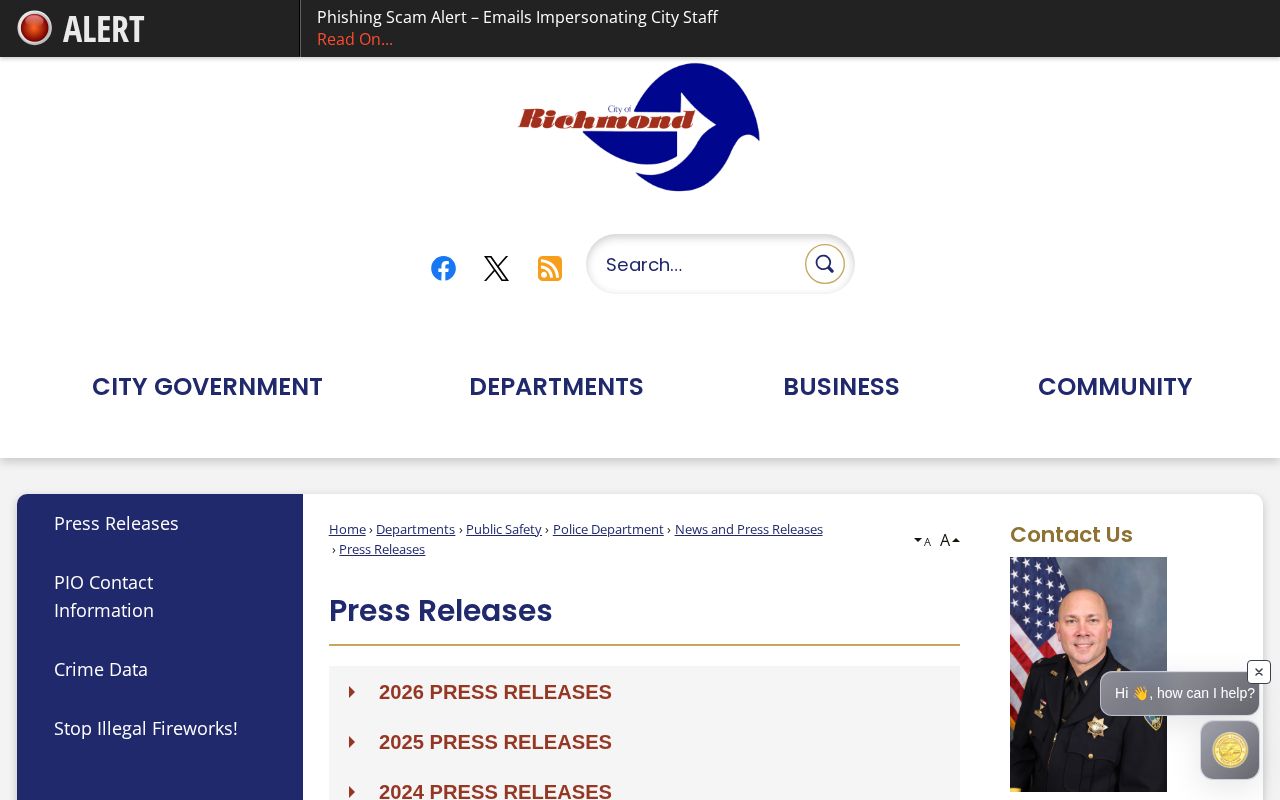
Press releases can document highlighted cases. They name names the log will not. Even so, they are selective. The daily incident log and the county custody locator still do the heavy lifting for Richmond recent arrests.
Request Richmond Arrest Records
The Richmond Police Records Section is the city's central repository. Its public line is (510) 620-6675. Lobby hours generally run weekdays, 8:00 a.m. to 7:00 p.m. Report production often takes seven to ten business days. Published fees list police reports at $10, traffic reports at $10, and clearance letters at $40. Active investigations, juvenile material, and other protected records can be withheld.
1701 Regatta Boulevard
Richmond, CA 94804
Records: (510) 620-6675
Non-emergency: (510) 233-1214
Fax: (510) 620-6880
Give the Records Section a narrow request. Include the incident number, date, location, and name. Ask for the city arrest or incident report. County custody goes through Sheriff Custody Administrative Services for an in-custody record. Records & ID answers out-of-custody inquiries. A Richmond report fee does not guarantee a booking photo. Ask for the photo as a separate, identified record. Request the legal basis for any withholding.
The Public Information Office handles police announcements. Its number is (510) 620-6942, and its email is RPDPIO@richmondpd.net. That contact suits clarifying a release, not running a full custody check. Records staff and the Sheriff remain the proper custodians.
Richmond Arrest Versus County Booking
West County Detention Facility sits inside Richmond. Still, a Richmond arrest does not mean the person is held there. Martinez and Marsh Creek hold county inmates too. The Sheriff's centralized locator covers all of them, along with some custody-alternative placements. So the facility on a result, or a direct call, settles the question. City geography does not.
A blank result carries several possible meanings. The person may have gotten a citation. They may have posted release, transferred out, or never entered county custody at all. Someone can also drop off the locator after getting out. If you have the incident but the locator shows nothing, hold onto the city incident number. Then file a focused records request. The Daily Arrest Report gives the county-wide picture. It also explains why no separate verified 24-hour Sheriff feed can be promised.
- Incident log
- A city operations record of a call or police event.
- Booking
- Formal jail intake after an agency delivers a person to custody.
- Release
- Departure from custody, which does not erase the city or booking record.
- Disposition
- The later court result, not the incident-log code.
Richmond Arrest Coverage Needs Checks
Richmond Standard crime coverage reports West County police events often. One of its stories described an arrest based on Richmond Police information. That person was booked in Solano County. The lesson sticks. A Richmond arrest story does not establish Contra Costa custody. Contra Costa News Richmond category offers a city-focused secondary route. East Bay Times and the San Francisco Chronicle cover the broader region.
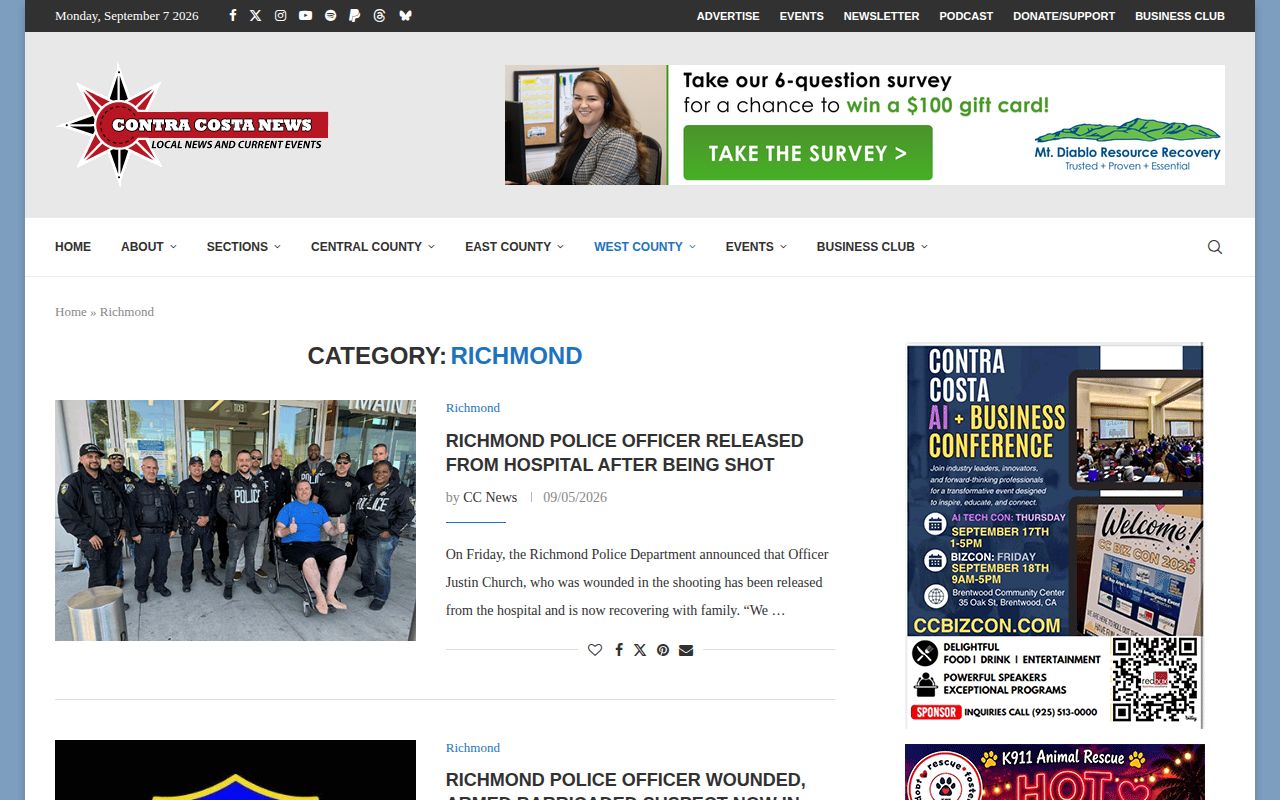
Treat news stories as leads. Verify custody and court status through official sources. RecentlyBooked runs a Contra Costa county page with recent-looking entries, and Mugshots.com carries historical pages. Both are unofficial. No aggregator should outrank Richmond Police, the Sheriff locator, or the Superior Court.
After a Richmond Arrest
The court layer comes next. Richmond keeps a criminal-record counter at 100 37th Street. The county also serves records through Martinez and Pittsburg. Online records do not include every minute, order, or case document. A mail or counter request may be needed.
A booking charge is only the opening fact of a case. A CAD entry reading "WARRANT ARREST" is no different. Compare the name and date carefully. The court holds the authoritative outcome, so let its records close the loop.